Case study · Nashville, TN · Biosolids thickening
Up to 10× the loading. Same footprint.
How Nashville Metro Water Services piloted Suspended Air® Flotation (SAF®) to add biosolids thickening capacity at its Central Water Reclamation Facility, and tested converting existing DAFT units into SAF® units with froth injection.
Pilot: June – August 2026 · Project team: Nashville MWS, Hazen and Black & Veatch
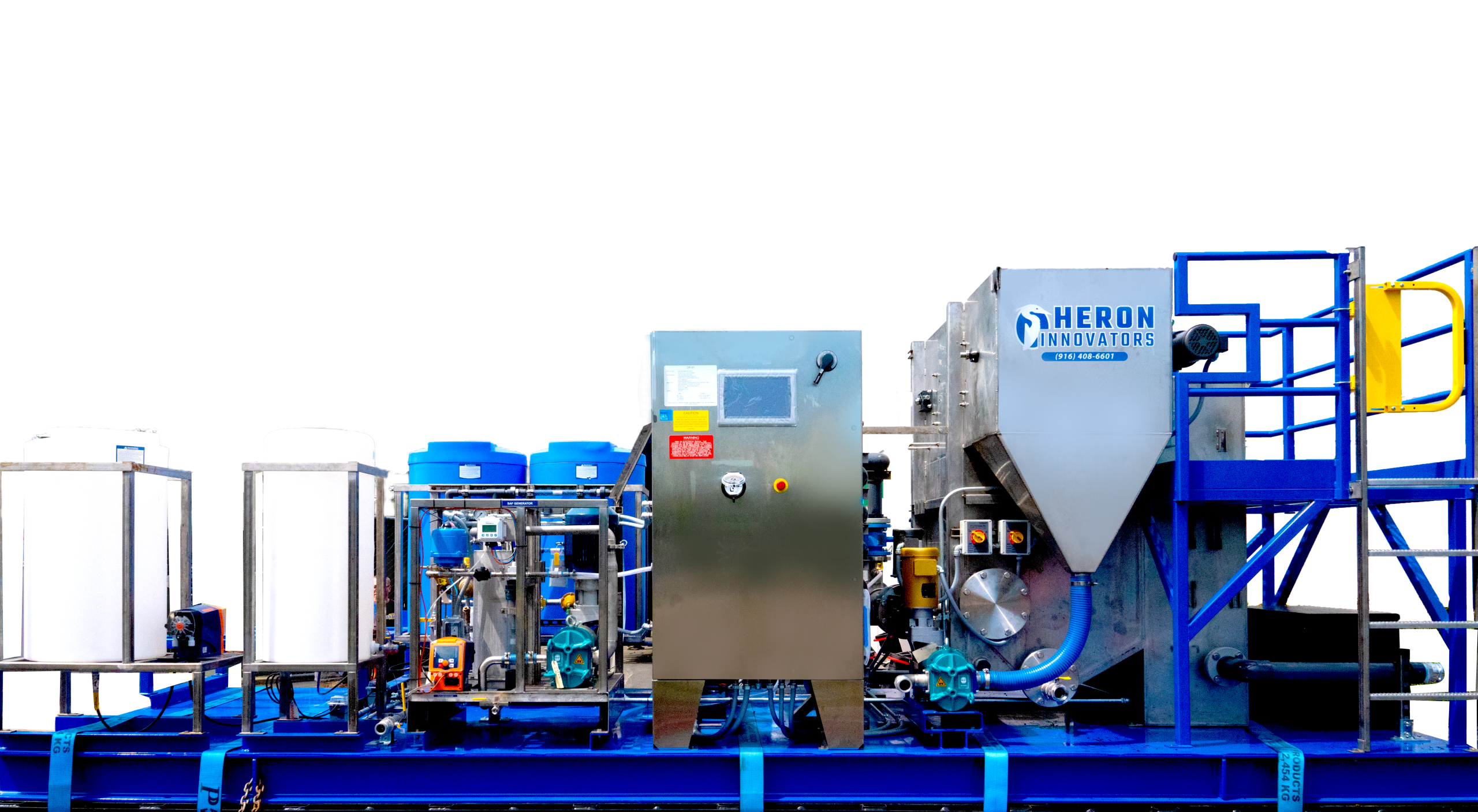
SAF® pilot skid (representative unit)
%
the solids loading rate of a conventional DAF thickener, on an equal surface area (approx.)
dry tons per day of new thickening capacity needed
dry tons per day: the Phase 1 firm thickening capacity target
%
the DAFT-alone loading, possible with froth-retrofitted DAFTs (preliminary)
Plus consistent 5–6% total solids thickened sludge with excellent effluent turbidity, on a roughly 75/25 primary/WAS blend.
The challenge
Why Nashville looked beyond more DAF tanks
Metro Water Services (MWS) is advancing improvements to the Biosolids Facility at Nashville's Central Water Reclamation Facility (WRF). The existing train of DAFT, anaerobic digestion, dewatering and thermal drying handles a blend of roughly 75% primary sludge and 25% waste activated sludge. Projections call for about 100 dry tons per day (DTPD) of additional thickening capacity, to reach a Phase 1 firm capacity of about 205 DTPD.
Five factors drove the team to evaluate SAF®:
- More thickening capacity to support future loading increases
- Significant site and footprint constraints on large new facilities
- A desire to maximize use of existing DAFT infrastructure
- Interest in much higher solids loading rates than conventional DAFT
- A scalable solution for future biosolids program expansion
Engineer's notes: tap to open
How does SAF® float solids without dissolved air?
Conventional DAFT relies on air dissolved under pressure. SAF® instead uses electrically charged, surfactant-coated microbubbles that attach to solids and promote flotation. That is how it sustains roughly ten times the solids loading of a conventional DAF thickener on an equivalent surface-area basis.
What's in Nashville's sludge?
About 75% primary sludge (PS) and 25% waste activated sludge (WAS). Downstream are anaerobic digestion, dewatering and thermal drying.
Pocket glossary
- DTPD: dry tons per day
- SLR: solids loading rate (lbs/hr/sf of flotation area)
- HLR: hydraulic loading rate
- TS: total solids (%)
- DAFT: dissolved air flotation thickener
- PS / WAS: primary sludge / waste activated sludge
Tip: dotted-underlined terms on this page show their definition on hover.
The pilot program
Three questions, one trailer-mounted skid
A trailer-mounted SAF® pilot skid and a separate froth generator were installed at the Central WRF Biosolids Facility. The pilot processed blended primary and waste activated sludge across a range of hydraulic (HLR) and solids (SLR) loading rates representative of full-scale operation.
01
Stand-alone SAF® thickening
Can SAF® reliably thicken the combined PS/WAS blend on its own?
✓ Complete · Jun – Aug 2026
02
DAFT conversion via froth injection
Can froth injection turn existing DAFT units into higher-capacity SAF® units?
● Ongoing · since Jul 2026
03
Downstream digestion impacts
Does SAF® surfactant affect anaerobic digestion performance?
● Data collection underway
Pilot data explorer
One sample week. 5.1–6.4% TS out.
Preliminary daily averages from the week of July 26, 2026. Switch metrics and tap a bar to see what each day did to the sludge.
Source: SAF® Nashville write-up, preliminary results. Concentration factor = thickened TS ÷ influent TS; volume reduction ≈ 1 − influent TS ÷ thickened TS (assumes similar sludge density). Calculated values are ours, not the project team's.
Back-of-envelope
How much flotation area would you need?
Slide to your solids load. We compare flotation surface area at the loading rates seen in Nashville's pilot week with a conventional DAF thickener running at one-tenth the loading, the ratio reported in the write-up.
That is - lbs of dry solids per hour.
Illustrative only, not a design basis. Real sizing depends on sludge characteristics, conditioning, HLR, redundancy and pilot data for your plant. Talk to Heron about piloting SAF® on your sludge.
The retrofit angle
Convert the DAFTs instead of building new
A unique part of the Nashville evaluation: integrating charged-microbubble generation into existing DAFT tanks and hydraulic systems with froth injection. Pilot testing indicated the integration appears feasible, and preliminary results suggest froth-retrofitted DAFT units may achieve upwards of double the loading of the DAFT alone, if long-term testing confirms pilot observations.
STEP 1
Retrofit one or two DAFTs
Install a full-scale froth generation system serving one or two existing DAFT units, and operate the modified system for about a year.
STEP 2
Confirm long-term performance
Check whether full-scale, year-long performance mirrors what the pilot showed.
STEP 3
Convert all four
If it does, all four existing DAFT units could be converted to SAF® service, eliminating the need for a separate SAF® building and significantly reducing capital costs.
Lessons learned
Five takeaways for your next thickening project
1. SAF® can significantly increase capacity in space-constrained facilities
For utilities with limited room to expand, SAF® provides a path to more thickening capacity without a major increase in footprint. High loading rates make it particularly attractive at urban facilities.
2. Existing infrastructure may have significant value
Existing DAFT facilities may be modified rather than abandoned. Reusing tanks and their associated infrastructure could substantially improve project economics and reduce construction impacts.
3. Upstream debris management is important
Pilot observations identified two factors that affected performance and startup reliability during the pilot, and what to design in to manage them.
4. Pilot testing is essential
The four things the pilot pinned down that gave the team confidence for full-scale decisions.
5. SAF® appears compatible with downstream biosolids processing
Early observations on anaerobic digestion and the final dried biosolids product, while data gathering continues.
Free download
Get the full Nashville write-up
Pilot Testing, DAF Conversion Evaluation, and Lessons Learned, from the project team of Nashville MWS, Hazen and Black & Veatch. Inside:
- Full project background and the factors behind the evaluation
- Complete pilot findings and the July 26 – August 1 data table
- How froth injection was integrated with existing DAFT tanks
- The phased strategy for converting all four DAFT units
- All five lessons learned in full, plus conclusions
Planning new thickening capacity?
Talk with Heron about piloting SAF® on your sludge or retrofitting your existing DAF thickeners. Or keep exploring: Enhanced Algae Removal with SAF®.